Pet Grooming at Golden's Care Center

Bathing, brushing, trimming and loving care. TAP TO BOOK NOW! →

Before Grooming – The Starting Point

Every makeover begins with gentle handling and proper coat care. BOOK NOW! →

After Grooming – Fresh, Clean & Fluffy

See the transformation! Book your dog's grooming appointment now! TAP TO BOOK NOW! →

Boarding • Daycare • Grooming & More

A caring home away from home for your dog in Port Harcourt. Contact us on WhatsApp. Chat on WhatsApp →

We Pick Up & Drop Off Your Dogs

Convenient, safe and reliable pet transport. Arrange your dog's pickup on WhatsApp. Chat on WhatsApp →

Showing posts with label Health. Show all posts

Monday, February 06, 2023

Why do dogs spin before they poo?


Not all dogs decide to spin before relieving themselves, although it is common. When a dog spin or circles round and round before he poops, he is doing several things which are;

1. PREPARING THE GROUND.
He is ensuring his safety, preparing his spot, tamping down the grass and chasing away any bugs or other creatures to give it a nice clean place to do its business. The circles allow your dog to get a good, clear view of the surrounding area to make sure there are no threats or predators near by when they are in such a vulnerable position.

2. CHECKING FOR NEAT SPOT.
Sometimes your dog spinning means he is looking for scents from other dogs or creatures to see who else has been in the area. Dogs just like we humans want a nice clean and hygienic place to do their business.

3. ALIGN THEMSELVES TO MAGNETIC POLES.
This may sound crazy but it possibly could be true as researchers at a university in Prague says dogs like to align themselves with the Earth’s magnetic poles, particularly the North-South axis. Czech and German researchers studied 70 dogs’ bathroom behaviors and learned that dogs align their bodies with the magnetic field before they poop. However, the researchers couldn’t determine if this behavior was conscious or unconscious behavior. It’s unknown if they feel better when aligned on the North-South axis or if it’s a physical reaction.

Keep in mind that not all dogs do the spin before they poo and dogs aren’t the only animals to align themselves to the magnetic poles when pooping. 

Tuesday, December 20, 2022

5 MAJOR REASONS WHY DOGS LICK THEIR PAWS


Why do dogs lick their paws?
There are so many reasons why your dog is licking his paws but today we will discuss about 5 major reasons, which are;


1. SELF GROOMING.
The most common reason your dog lick its paws is as a part of self-grooming. Even dogs that don't do a lot of self-grooming will occasionally clean their paws. If you notice your dog licking its paws every once in a while, then there's probably nothing to worry about as it's a normal behavior in dogs especially when they come inside after walking on dirty or sandy ground.

It is not normal if your dog seems to be licking its paws frequently or aggressively. This is usually a sign of a health problem, injury or a behavior issue.


2. INJURIES.
If you think your dog's paw-licking is abnormal, The first thing to do, especially if the licking begins very suddenly and is focused on one paw, is to examine the paws to make sure there is not an injury such as a cut, torn nail, ice ball stuck between the pads, growth, or maybe a stone, or thorn. Take a look at the nails very well, check between the toes and pads, and at the tops of the feet.

Maybe your dog have irritated his paw by stepping on a sharp object, walking on hot or salted sidewalks, stung by a bee, or getting a blister. Some of these problems can be relieved by a simple first aid treatment, while others might require treatment by your veterinarian.


3. EXTERNAL PARASITES.
Parasite infections such as Ticks, fleas or mange can make your dog paws to be very itchy. Your veterinarian can recommend treatments to eliminate the parasites, which should relieve the itching.


4. PAW ALLERGIES.


If your dog has itchy paws, allergies may also be the cause. Allergies are common and can be caused by the environment, food, or an irritant that comes into contact with your dog’s skin. Food allergies are known to cause itchy paws, and these types of allergies are difficult to pinpoint. Your vet may suggest a special diet or elimination of certain ingredients in your dog’s food to try to alleviate the problem. Dark pigmentation, Redness, or brown staining on the paws from constant licking may be signs of allergies. Bathing or wiping your dog’s paws after going outside will reduce the allergens on your dog’s skin.

Your veterinarian will prescribe topical creams or sprays with hydrocortisone to temporarily reduce the itch, but more intense licking requires systemic medication (prescription meds that affect the entire body) to control.

5. PAIN.


This is one of the most common reason your dog lick its paws. A dog that is experiencing pain due to arthritis or other foot or leg conditions may lick his paws. Even if the pain is somewhere else in their body, (the affected area may be sensitive and appear swollen). Some dogs will try to deal with it by licking a front paw continuously.
Your dog will need to be diagnosed and treatment by a veterinarian.

These above are the 5 major reasons your dog is licking its paws.


HOW TO PROTECT YOUR DOG’S PAWS


Here are a few ways you can protect your dog’s paws.

DAILY PAW CHECK.


You should try and make it a daily habit of checking your dog’s paws closely as it will help you catch problems early so they can be easily corrected.

Be sure to examine the top and bottom of the paws, along with the toes, nails, toe pads, and between each paw. Look for any indication of injury, irritation, objects, or any obvious abnormality.

PAW MOISTURIZER


Protecting your dog’s paws may include moisturizing them on a regular basis(2-3times weekly) with a pet-specific moisturizing cream or Lotions.
Washing your dog’s paws or thoroughly wiping them with a clean cloth after walks will decrease the environmental allergens on the skin.

NOTE: Be sure to avoid human lotions and medications, as these are not safe for dogs to ingest.

TRIM YOUR DOG'S NAILS.


Keeping your dog’ nails trimmed will ensure that they do not overgrow into the paw or become painful when your dog walks.


Thanks for reading this article 😊 Please drop your comment and don't forget to share with others.

Saturday, September 17, 2022

Can my dog eat egg?


Dogs can have eggs. In fact, they are a wonderful source of protein. And protein is essential for dogs. “Eggs are considered a gold standard because they’re almost the closest you can get to 100 percent complete, as far as protein goes,” Purina Senior Nutritionist Jan Dempsey explains.

ARE EGGS GOOD FOR DOGS?

Yes. Eggs are good for dogs to eat. Of course, they are rich in protein, but aside from that eggs are also a good source of linoleic acid and fat-soluble vitamins like Vitamin A. All of these are wonderful for a dog’s skin and coat,” says Dempsey.

ARE RAW EGGS BAD FOR DOGS?

Well raw eggs are not advisable for dogs a they can be a source of Salmonella. Even very clean eggs can have it inside. And as eggs start to go bad, they can grow other bacteria. Some foods can lose nutrients while they are cooked, but the protein in eggs isn’t. Cooking really helps make them more digestible. So however they are prepared–boiled, scrambled, sunny side up–cooked is best for your dog.

ARE EGG SHELLS NUTRITIOUS FOR DOGS?

“Egg shells contain calcium and phosphorus,” says Dempsey. “But there are easier ways to supplement those minerals.” Instead of grinding up egg shells, talk to your veterinarian. She will know if your dog needs something added to his complete and balanced diet.

IS THE CHOLESTEROL IN EGGS BAD FOR DOGS?

You don’t need to worry about cholesterol and your dog. “Cholesterol doesn’t have the same effect in dogs as it is does in humans,” Dempsey explains. “And dogs don’t get to the same cholesterol-related diseases as humans.” That means you don’t need to feed egg whites only. If your dog is taking in too much egg, you will see weight gain due to too many additional calories long before any other issues arise.

CAN DOGS EAT AN EGG A DAY?

Dogs can eat a little bit of egg each day, but it’s important to feed eggs like you would any treat. “Eggs are about 70 calories each, so how much you feed depends on your dog’s size. Keep the 10 Percent Treat Rule in mind. The egg you feed should only make up 10 percent of your dog’s total daily calories. That way he has his complete and balanced meals and no extra calories,” explains Dempsey. And it will help eggs remain a surprise your dog looks forward to receiving.


Culled from: Purina.com

Sunday, September 11, 2022

A kiss of death: Pet owner dies after getting licked by his dog


Image for illustration purposes only. 

In a devastating turn of events, a little lick from his dog proved fatal for a 63-year-old man, who died after catching a rare infection from his pet’s saliva. According to news reports, the pet owner was admitted in the hospital after he complained of flu-like symptoms including high fever and muscle aches for three days.

The case study is mentioned in the European Journal of Case Reports in Internal Medicine.
The man’s condition got significantly worse as he started facing difficulty in breathing and developed painful blisters on his face, excruciating pain and unexplained bruises on his legs. Furthermore, he was diagnosed with severe sepsis as his organs began to fail and he suffered from brain damage.

Ultimately, his skin started to rot away and his liver started shutting down, leading to a cardiac arrest. The cause behind this deadly infection was Capnocytophaga canimorsus, a type of bacteria which can be found in the animal saliva. This fatal bacteria can be spread through bites, scratches or even licks of household cats and dogs.

While most people who come in contact with the Capnocytophaga, bacteria do not fall ill, one can never be too careful. It is also fatal in around 28 to 31 percent of cases

What you need to know
If you feel feverish or develop flu-like symptoms and have a pet at home, pay close attention to whether the symptoms are getting more complicated. The team, led by Dr Naomi Mader, wrote: 'Pet owners with flu-like symptoms should urgently seek medical advice when their symptoms exceed those of a simple viral infection, which in this case were (breathing problems and rash).

Should you let your dog lick you
Pet owners especially dog-lovers often treat their furry family members like their own babies. From talking, hugging to even kissing them, most people love to pamper their four-legged friends.
However, before you let your dog lick you in affection, it is important to understand that there are more than 700 different types of bacteria in a dog's mouth. Although it is highly unlikely, your dog’s disease-carrying saliva can also cause a fatal infection. The risk factor goes up for pregnant women, elderlies, babies and those with a weak immune system.

It is especially important that you steer clear of your pooch’s saliva if you have a wound or a broken skin, as it can be easily absorbed through the open sores.

Friday, December 04, 2020

How to Get Rid of Fleas: Detection and Prevention - Cesar's way.


Although fleas can be a problem for your pets all year, flea populations typically explode about five to six weeks after the weather starts to warm up. So pay special attention to flea prevention in the spring and early summer months and make sure you know how to get rid of fleas.

Spotting the Culprits

Black specks on your dog or in your dog’s bed may be “flea dirt” – the fecal matter from adult fleas. There are two easy ways to check for black specks:

  • Run a flea comb over your dog, making sure the comb reaches the skin through the coat. If black specks are on the comb when you pull it off, they might be flea dirt. If fleas are on the comb, drown them in a bowl of soapy water before they can get away or jump back on your dog. You can get a flea comb from your vet or pet retailer. Metal ones are the best.
  • Or place a white paper towel beneath your pet and rub your hands across its fur. If black specks appear on the towel, it may be flea dirt.

If infested with fleas, your dog may become very nervous, annoyed and may scratch excessively. When you discover fleas on your dog, your home is probably already part of the problem. There will be eggs, larvae, and pupae wherever your dogs like to lie around or sit. It’s time to take action!

There are four parts to the treatment of a flea infestation:

  1. Kill adult fleas that are already on your dog.
  2. Kill newly-arriving adult fleas on your dog. It may take three or flour months to kill all the new adult fleas emerging from pupae in the household environment.
  3. Prevent further infestation of the home by using an insect growth regulator (IGR) to inhibit the hatching of viable flea eggs and prevent the development of larvae into adult fleas.
  4. Clear the home and the environment of flea eggs, larvae, and pupae that are already present.

You can achieve the first three by treating your pet regularly with a product that contains two active ingredients (one to kill adult fleas, the other to prevent the development of eggs and larvae.) Ask your veterinarian for the appropriate recommendation for your dog.

Flea pupae are protected by their cocoons – all pupae will have to hatch out and be killed as adult fleas on the pet. It can take several weeks for all pupae to hatch in an infested environment. If undisturbed, pupae can exist for many months in the environment, which is why encouraging them to hatch (by allowing your pets to roam their usual haunts) and regular flea treatment are important in helping to rid a home of an infestation.

Be sure to treat all dogs and cats in your home, using appropriate treatments recommend by your vet. Some pets are good at masking the signs of a flea infestation. But if one pet is infested, all pets in the household can be. This is why knowing how to get rid of fleas ahead of time can prove to be very beneficial.

Preventing Future Infestations

In addition to applying a vet-recommended flea prevention product, the following steps can also help prevent fleas from infesting your dog:

  • Frequently vacuum the areas your dog frequents, especially carpeted areas in your home, any furniture that is frequented by your dog, and your car (if your pet rides in your car). This will clean up as many immature fleas (eggs, larvae and pupae) as possible.
  • Regularly wash your pet’s bedding, blanket and other washable items in the hottest water possible (check the laundering instructions to make sure that washing in hot water won’t harm the item).
  • Keep your yard neat. Mow your lawn and rake up any leaves, brush or clippings.
  • Periodically hang door mats, rugs and other non-washable items in direct sunlight.

It’s Worth the Effort

In addition to extreme discomfort, fleas and ticks can also cause serious health problems in dogs and people.

  • When a flea bites your dog, it deposits a small amount of saliva in the skin. Your dog can develop Flea Allergy Dermatitis (FAD) in reaction to this saliva, which causes severe itching. In addition to your pet scratching or biting excessively around the tail, groin or backside, scabs or bumps may also appear on your pet’s neck or back.
  • Anemia may occur in pets if too many fleas suck their blood. The signs of anemia include pale gums, weakness and lethargy in your pet.
  • Dogs may become infected with tapeworms by ingesting an infected flea. Pets may have intense anal itching, and tapeworm segments may be seen around the anal area or in the feces

Wednesday, December 02, 2020

Ten Tips for Taking Care of Your Dog


Here are 10 Tips for Taking Care of your Canine companion. 


1. PROVIDE A PROTECTED AND CLEAN LIVING ENVIRONMENT FOR YOUR DOG. 


Shelter from the elements and hazards, as well as good hygiene, are basic to a quality life.       


2. ALWAYS KEEP FRESH WATER AVAILABLE. 


Maintaining optimal hydration is important for health and energy.


3. FEED A QUALITY DIET AND PREVENT OBESITY. 


Overweight humans and animals can adversely affect health in many ways. Follow the dietary recommendations that your veterinarian will make according to the nutritional needs of your dog, based on size, age, level of activity and breed. Remember to provide healthy treats rather than table scraps, as rewards.


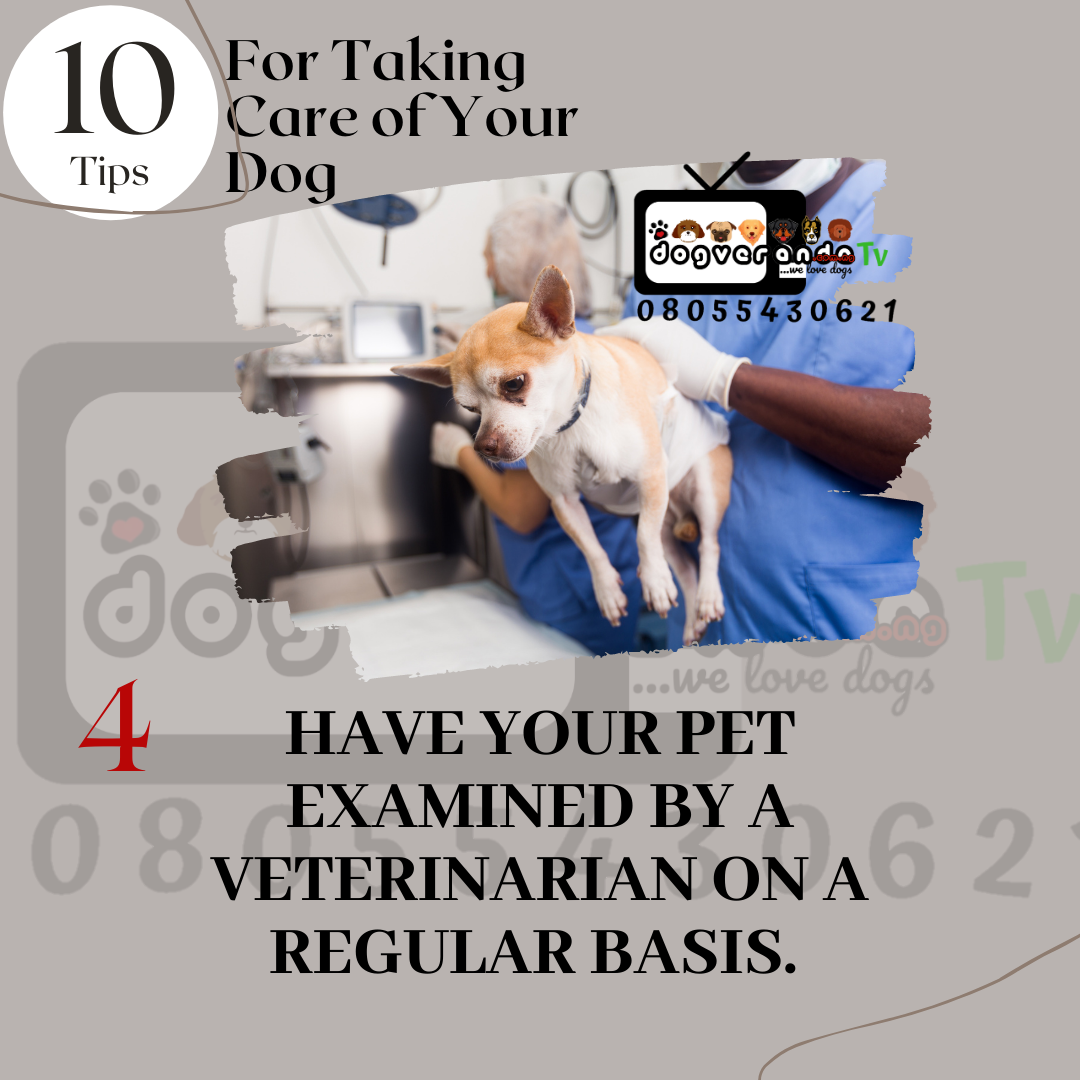
4. HAVE YOUR PET EXAMINED BY A VETERINARIAN ON A REGULAR BASIS.


Your veterinarian will provide you with the information on vaccination schedules, deworming and external parasite control. Keep a copy of your pet’s vaccination records in your home or with you when you travel. Contact your veterinarian if you believe that your pet may be ill, injured, or if something just doesn’t seem right. Your veterinarian is the expert on keeping your dog healthy.  Work as a team with him or her.


5. PROVIDE AMPLE OPPORTUNITIES TO EXERCISE. 


Make sure your dog gets the regular exercise needed to enable it to be fit.  By being in shape, your dog will be more capable of participating in the activities that it enjoys.


6. COMMUNICATE WITH YOUR DOG AND DEVELOP A RELATIONSHIP. 


Dogs are social creatures and they need to interact with their owner. Quality time will help you get to know your dog and understand  particular needs that it might have, as well enhance your ability to recognize early signs of an illness that could be developing. In addition, time spent in developing a relationship will help prevent many undesirable behavioral patterns. 


7. TRAIN YOUR DOG TO FOLLOW THE SIMPLE COMMANDS. 


Puppy and dog training classes can be very helpful. The better your dog is at following basic and necessary commands, the greater the chances are that your dog will live a safe and long life.


8. PRACTICE REPRODUCTIVE CONTROL.


If you do not intend to create puppies, spaying or neutering is a certain option. If you plan to breed your dog or are opposed to spaying and neutering for other reasons, take appropriate measures to prevent mismatings. Consult with your veterinarian in regard to other options that are available.


9. DENTAL CARE IS VERY IMPORTANT. 


Many breeds are prone to gum disease, which can have serious implications. Infection resulting from this condition leads to premature tooth loss, and can commonly cause infections in major organs, including the heart valves.    


10. DON’T OVERLOOK GROOMING AND NAIL TRIMMING. 


Long coated dogs are prone to developing matts and ice balls in their hair. Overgrown nails are common in elderly dogs and can make it more difficult for them to walk. In addition, such nails are much more prone to breaking, which can be quite painful.     


IN CONCLUSION, KNOWLEDGE IS POWER. READ UP AND LEARN AS MUCH AS POSSIBLE ABOUT YOUR DOG’S BREED SPECIFICALLY, AND ABOUT RAISING, TRAINING AND LIVING WITH DOGS, IN GENERAL. THE MORE YOU KNOW, THE MORE CONFIDENT YOU’LL BE IN PROVIDING A SAFE AND ENJOYABLE HOME FOR YOUR DOG. 

By Dr. Stuart Nelson, Jr., DVM
(Chief Veterinarian, Iditarod)

Tuesday, August 27, 2019

Common Causes of Sudden Death in Dogs


Losing a dog is never easy, no matter the circumstances. But losing one suddenly to an accident or serious medical event can be baffling, shocking, and terrifying.

These are the most common causes of sudden death in dogs, so you can be aware and do what you can to avoid them affecting your canine companion.

  • GDV: BLOAT

GDV, which stands for gastric dilatation and volvulus, is a condition in which a dog's stomach becomes inflated with gas, then twists on itself. The result is death of the blood vessels in the stomach, further inflation of the stomach, decreased blood flow to the rest of the body, shock, and death.

Large, deep-chested dogs over 5 years old are at highest risk for developing GDV. Feeding dogs multiple small meals a day, avoiding stressful situations as much as possible, not allowing your dog to exercise immediately before or after eating, and using an anti-bloat bowl can all decrease a dog's risk.

Talk with your veterinarian to determine whether your dog is at higher risk for developing GDV. 


  • TOXIN INGESTION

Ingesting toxins is another common cause of sudden death in dogs. This can include chemicals, medications, and human foods.


It's extremely important to be aware of and restrict your dog's access to things that are toxic. This includes human foods like chocolate, alcohol, and grapes. More sneaky substances like xylitol can be present in human foods, causing them to be extremely dangerous to dogs when they otherwise wouldn't be.


  • HEART PROBLEMS

Heart conditions are the biggest cause of sudden death in dogs. Blood clots, abnormal heart rhythms, cardiomyopathy can all cause sudden death.

It's important to have your dog checked by a veterinarian routinely, even if there are no signs of illness. If the veterinarian hears a heart murmur or arrhythmia, further testing may diagnose a heart problem that may be able to be treated. Not all heart conditions can be caught this way, but some can.


  • INTERNAL BLEEDING

Sudden death can happen quickly in cases of internal bleeding. This may be triggered by trauma such as being hit by a car. Internal tumors that begin bleeding, such as hemangiosarcoma, can cause death quickly without the owner being aware that anything is wrong.


Source: Doghealth.com

Friday, July 19, 2019

Facial Swelling in Dogs


Facial swelling in dogs can occur for a variety of reasons. In general, a swollen face is secondary to another problem. The cause of facial swelling may or may not be serious. However, it almost always requires medical intervention. Most commonly, facial swelling in dogs occurs as a result of an allergic reaction.

CAUSES OF FACIAL SWELLING IN DOGS
There are many possible reasons why your dog has a swollen face. Because facial swelling is a sign of an underlying problem, these dogs will often show other signs of illness, such as lethargy and loss of appetite.

ALLERGIC REACTION
Allergies are among the most common reasons for facial swelling in dogs. When a dog's face suddenly becomes swollen, it is usually caused by an allergic reaction. Allergic reactions may be brought on by bug bites, bee stings, vaccinations, medications, foods, toxin exposure, pollen, and other environmental allergens.

Allergic reactions cause an inflammatory response in the body. This can lead to hives and swelling, especially on the face. You may especially notice swelling of the muzzle and eyelids. The neck may be swollen as well and even affect breathing. Some allergic reactions will get worse quickly, leading to serious problems breathing or even seizures. Mild reactions tend to improve with little intervention, but major reactions are considered emergency situations.

DENTAL ISSUES
Facial swelling may be related to a problem with the teeth or mouth. Tooth abscesses and other dental infections can go deep beneath the gums and cause a pocket to fill with pus. This usually causes a dog's face to become swollen, especially beneath the eye. Broken teeth, oral injuries, and periodontal disease may also make a dog's face swell up.


TRAUMA
An injury to the face, head, or skin can lead to facial swelling. Common injuries like animal bites and other wounds can lead to infections that cause swelling. Snake bites often cause swelling of the face and neck, even if the bite is located elsewhere on the body.

TUMORS
Abnormal growths can occur on the face and head. Sometimes cancerous, tumors can cause pain and pressure buildup. Whether they are benign or malignant, facial tumors may spread and grow, causing damage to the facial nerves, muscles, and bones. Cysts are fluid-filled growths that are often benign, However, they can become quite large and visible, especially on the face.

TREATMENT OF FACIAL SWELLING IN DOGS
The proper treatment of facial swelling in dogs usually depends on the cause. Before proceeding with treatment, it's important to contact your vet for advice.

Extreme allergic reactions and major infections may cause the airway to become swollen, obstructing breathing. This is an emergency situation; get to the nearest open veterinarian immediately.

Mild to moderate allergic reactions may be treatable at home using medication. A reaction is considered mild to moderate if your dog is breathing normally and acting relatively normal (no more than slightly lethargic). In these cases, your vet may recommend giving an over-the-counter antihistamine. If your dog's face is swollen for some other reason (or unknown reasons), the next step is to bring your dog to the vet for an exam. Your vet will recommend treatment based on the diagnosis.


Facial swelling due to dental or oral problems may require professional dental work. The dog is often treated first with antibiotics and anti-inflammatory medications before coming in for anesthesia and a full dental cleaning and examination. Dental x-rays may be done while your dog is under anesthesia. Depending on the cause, the vet may need to extract teeth or perform another kind of oral surgery. Your dog may be sent home with antibiotics to treat or prevent infection.


If a trauma has occurred to the face or head, treatment depends on the severity of the injury. X-rays may be necessary to determine the severity. Begin by providing any first aid that is necessary, then get to the vet right away. Treatment often involves antibiotics, anti-inflammatory drugs, and supportive care. Serious injuries may require surgery. Snake bites are treated with supportive care and sometimes antivenin (if available and deemed necessary).

If your vet suspects a tumor and/or cancer, further testing will be needed to learn more. Your vet may recommend blood tests, x-rays, and testing of the tumor itself (usually a fine needle aspirate or biopsy is sent to a pathologist for microscopic analysis). Treatment depends on the diagnosis. Cancer may need to be treated with chemotherapy, radiation, and/or surgery.

HOW TO PREVENT FACIAL SWELLING IN DOGS

You can prevent someone forms of facial swelling in dogs by protecting your dog from the things that cause facial swelling.

If you know your dog has allergies, try to minimize exposure to allergens. If approved by your vet, use antihistamines as prevention. If your dog is known to have vaccine reactions, make sure your vet knows so your dog can be treated in advance, minimizing the reaction. If you see that your dog has been bitten by a bug, stung by a bee, or otherwise exposed to an allergen, treat right away with an antihistamine (ask your vet for advice on this).


You can easily prevent most dental issues by taking good care of your dog's teeth. Begin a dental care routine for your dog and stick to it. Your dog will be much less likely to develop a dental problem and you will be more likely to catch issues early on.

Trauma cannot always be prevented, but you can take steps to keep your dog safe in general. Do not let your dog roam free or play off-leash in non-fenced areas. Supervise interactions with other animals so you can prevent fights. Bring your dog to the vet right away if any kind of trauma occurs.

Tumors and cancer cannot really be prevented. However, early action can minimize the damage done. If you notice your dog has a swollen face, it's important to act right away.

Tuesday, June 18, 2019

Foods that Help Prevent Dog Cancer

1. EGGS.

Eggs are really the perfect food. A source of complete protein, low in calories, and high in vitamin D3, a known contributor to cancer prevention. Dogs will relish the chance to eat an egg every morning any way you want to fix it. Raw, boiled, fried, or scrambled your dog will be down with the egg. Cook it up in a bit of that oil with good fat and get a double dose of cancer blocking.


2. FISH OIL OR JUST FISH

Fish or fish oil (supplement) has wonderfully healthy levels of good fat for your dog. It also contains vitamin D3 making it even stronger force against would-be cancer lurking around your dog’s system. Salmon, sardines, cod, and shrimp are great options for dogs. Choose wild over farmed for their higher levels of nutrients.


3. PALM FRUIT OIL

Palm fruit oil contains tocotrienols, or a form of biologically active vitamin E. Multiple studies have been done that show that tocotrienols trigger the death of cancer cellsand block the spread of cancer cells. Palm fruit oil also boosts immunity, improves eye health, helps control blood sugar, and improves absorption of vitamins and minerals. Mix in with other foods and enjoy the cancer fighting benefits of this oil.


4. BROCCOLI  & OTHER  VEGGIES

Broccoli belongs to the cruciferous vegetable family, which includes kale, cauliflower, Brussels sprouts, bok choy, cabbage, collard greens, rutabaga, and turnips. These nutrition powerhouses supply loads of nutrients for few calories.

These mini green trees top nearly every list of canine cancer fighting foods. They are chock full of antioxidants, which are the main players in cancer butt kicking.


Think of antioxidants as little crime fighters that circulate through a being’s system eradicating infant cancer cells before they become fully grown and spread their killer seed.


In addition to antioxidants, broccoli has loads of vitamins and minerals that are anti-allergy, anti-inflammatory, and anti-microbial. Talk about an immunity booster!


The greens on top can be irritating to your pup’s system (gas attack!) so it’s best to stick to the stems. It's still taste Delicious and fun to eat, too!


5. BERRIES

Some of the less common berries found in the wild are toxic to dogs and humans. As a rule of thumb, blueberries, strawberries, blackberries, and raspberries are safe for dogs to eat... However, berries commonly consumed by humans are generally safe for dogs.


6. COCONUT, FLAX & OLIVE OIL

Feeding only commercial dog food to your pup lacks sufficient quantities of good fats. These are the fats that give our bodies essential fatty acids and fuel. Importantly, good fats allow our bodies to absorb and make use of all those good vitamins in our foods without the bad cholesterol that clogs our arteries.


Coconut oil, flax oil, and olive oil are all great choices for dogs due to their tolerance as well their tastiness. They are super simple to administer, as well. Simply add some to anything your dog is eating. Mixing an appropriate amount over kibble is an excellent way to boost the nutritional value of your dog’s meal as well as its yumminess.


7. PARSNIPS

Parsnips are an excellent source of many important nutrients, packing a hearty dose of fiber, vitamins, and minerals into each serving...

They're rich in Antioxidants, high in soluble and insoluble fiber, boost your dogs immune function and are delicious and easy to add to your dogs diet.

Many dogs love carrots and will eat them raw as treats. Parsnips can be fed raw in cut up chunks or cooked if your dog tends to swallow things without chewing.

They prevent cancer via the all powerful antioxidant and vitamin K for bone health.

10 Things You Do Your Dog Hates.

Dogs often tolerate human behavior because they are loyal and easygoing. However, there may be some things that you or others do that your dog secretly hates.

1. LONG EYE CONTACT!

Staring at your dog for too long is a no, no – especially, with strange dogs! Eye contact between dogs is the way by which they set their roles and dominance within the pack. At often times, eye contact turns fatal – be it a dogfight for position or simply connoting aggression! Therefore, eye contact may confuse your dog! Although, they will tolerate you as an owner, do not practice it often! When it comes to strange dogs, remind yourself to avoid it altogether as you never know what kind of reaction you might trigger!

2. HUGGING YOUR DOG
Hugging is the best way for us humans to express love and gratitude in-between each other.

Many dogs do not enjoy hugs, especially from strangers. Placing your arms around a dog's neck or body may be perceived as a threat. Most dogs tolerate gentle hugs from trusted humans, but that doesn't mean they actually like them.
A better alternative is to let the dog cuddle on his own terms and pet him along the back and on the chest (especially if you don't know the dog well). Of course, some dogs do love to be hugged. It's important that you know your own dog and understand his limits. Pay attention to his body language to help you understand how he is feeling when you hug him. If he leans away, averts his eyes, yawns, licks his lips, has a worried look, or shows other appeasement gestures, he's probably uncomfortable.

3. USING WORDS MORE THAN BODY LANGUAGE
Did you know dogs are the experts at reading our thoughts and feelings before we even organize and express them?

 The best method of communicating with your dog is by adjusting your body language and posture before pronouncing a single word! Coordinate your words with your posture, otherwise, you may be sending mixed signals to your dog! Instead of understanding your command, you rather confuse the dog and make them act even worse than in the beginning!
Try practicing body language for a full day, by not speaking a word when communicating with your dog! See if they understand you better!


4. PETTING DOGS ON THE HEAD

Petting your dog's face or patting her on her head is another wrong way of showing affection towards them! Although most dogs do like it, it may seem natural, it is one form of interaction that brings uncomfortable feelings in dogs! Dogs will be dogs, they are not babies – keep in mind!


5.  NO SNIFFING AND EXPLORING ON WALKS(outing).


Dogs like going on walks for more than just the exercise. Taking a walk outdoors gives your dog a chance to explore the world. Your dog explores the world primarily through scent, then with his other senses (whereas most humans explore the world first through sight). Rushing your dog through a walk without allowing him to stop and sniff (and mark) is unkind. If you think about it, it's like someone dragging you by the arm through your favorite shop without allowing you to stop and look at anything. If it happens all the time, that would be pretty frustrating, wouldn't it? So next time you walk your dog, give him plenty of time to explore his environment.

6. Lack of Routine and Rules

Most dogs may not seem to like it, but dogs needs rules. If your dog is acting out, it's probably because you have not taught him the rules. Training is an important part of providing structure in your dog's life. A routine is important because your dog has an internal clock. Try to feed your dog at the same time each day. Establish an exercise routine too if possible. After a few days of structured rules and routine, you will probably notice that your dog is happier. Routines and rules make your dog's world more predictable and can actually boost his confidence.


7. DRESSING THEM UP

Most dogs will tolerate outfits or costumes, but many don't enjoy them. Get to know your dog before you force him into a bunny costume! Some dogs are fine with simple clothing items like shirts, but loathe wearing things on their heads or feet. How important is it that you dress up your dog anyway? If your dog needs protection from the cold, start with small, lightweight items and associate them with treats or other rewards. Work your way up to sweaters, jackets, and booties. Watch your dog's body language to determine when he has had enough.


8. HARD/STRONG FRANGRANCES

Did you know your dog's sense of smell is about 10,000 to 100,000 times more sensitive than yours?

 In general, dogs enjoy taking in all types of scents and odors. However, strong fragrances and chemicals can bother dogs and even irritate their noses.
As a rule, it's best to avoid directly spraying your dog with anything. If your dog needs a medical spray applied, avoid his face (better yet, spray the medication on a cloth and apply it to him that way). When you use your own products (perfume, hairspray, air fresheners, cleaners, etc.) do so away from your dog and make sure the product is not toxic.

9. KEEPING A TIGHT LEASH

By keeping a tight leash on a dog, you’re raising the level of stress, frustration, and excitement for your dog. 

This is why it is so important to teach a dog how to walk on a slack leash.

An amazing amount of energy is transferred between you and your dog through that little strip of canvas or leather. By keeping a loose leash, you’re letting your dog know that everything is fine and dandy, that there’s no reason to be worried or tense. With a slack leash you’re saying to your dog that you are calm and have everything under control so your dog is free to be calm as well. On the other hand, by keeping a tight leash you’re sending a message to your dog that you’re tense, nervous, on alert, ready to fight or fly, and your dog responds in kind. Just as you don’t like your dog pulling you around, it doesn’t feel good to your dog to constantly be pulled and thus cued to be on alert. They’re also well-aware that they can’t get away from you even if they think they need to. A dog that walks on a tight leash is more apt to bark or be reactive in even the most mild of social situations. But a dog that can walk on a slack leash is more likely to be calm. This is a difficult thing to master, and something the majority of dog owners can commiserate about, but it is so important to having pleasant walks with a relaxed dog.

10. TENSE AND BORED MOOD

We never enjoy been Tensed or Bored – dogs likewise! If you notice your dog seeming bored or tense, just make sure you check with yourself first as your dog is mostly mirroring your feelings! Having busy schedules, when you're supposed to relax. Spend as much time as possible with your dog when you're free at home. Take the time to bond with your dog. Set a daily routine, providing plenty of exercise and mental stimulation. If you travel frequently, find a trusted pet sitter with whom your dog is comfortable. If you travel constantly, consider whether or not it's fair to even have a dog.

Wednesday, June 12, 2019

Human Food Dogs Can Eat And Can't Eat

Seeing your dog starve is as painful as seeing a child cry. Here's a list of dog-approved human foods, as well as some items you should never share with your canine companion.

Keep in mind though that dogs are different, so try these foods in small amounts, and if your dog has a reaction to any of them, consult a veterinarian.


  • Can eat: Oatmeal.

Oatmeal is a good source of fiber, making it great for dogs with bowel irregularity issues, and it's also safe for dogs with wheat allergies. Before serving it to your pet, cook the oatmeal and don't add any sugar.


  • Can eat: Chicken.

Chickens are very good for your dog. If your dog requires extra protein in his diet, cooked, unseasoned chicken is an easy addition to his regular food. It also makes a good meal replacement if you're out of dog food.


  • Can't eat: Ice cream.

No, dogs shouldn’t eat ice cream. As refreshing of a treat as ice cream is, it contains lots of sugar so it is best not to share with your dog. Some canines have an intolerance to lactose. To avoid the milk altogether, freeze chunks of strawberries, raspberries, apples, and pineapples and give them to your dog as a sweet, icy treat.


  • Can't eat: Macadamia nuts. 

No way! dogs should not eat macadamia nuts. These are some of the most poisonous foods for dogs. Macadamia nuts, part of the Protaceae family, can cause vomiting, increased body temperature, inability to walk, and lethargy. Even worse, they can affect the nervous system. Never feed your dog macadamia nuts.


  • Can eat: Milk.

Yes, dogs can have milk. But be cautious. Some dogs are lactose-intolerant and don’t digest milk well. While it is OK for dogs to have a little milk, owners should be cognizant of the symptoms of lactose-intolerance and might want to stick to giving their dogs water.


  • Can eat: Broccoli.

This vitamin-rich vegetable can be a great occasional nutrition boost for dogs. However, it shouldn't make up more than 10 percent of a dog's diet as it could cause gastrointestinal irritation.


  • Can't eat: Pumpkin.

 Yes, You can serve your dog pumpkin — raw or in a can — as a source of fiber or vitamin A. It's also a helpful addition to doggie diets if your pooch is experiencing digestion problems.


  • Can't eat: Chocolate
Never! You've likely heard that you're never supposed to feed a dog chocolate, and there's a reason for that. That delicious candy contains caffeine-like stimulants known as methylxanthines. If ingested in large amounts, chocolate can cause vomiting, diarrhea, irregular heartbeat, seizures and even death. So don't ever try to give it to your dog except you want to lose your dog.


  • Can eat: Eggs.
If your dog needs a protein boost, scramble an occasional egg for a healthy snack. Eggs are high in protein, but they're also high in fat, so don't give your pet too many of them. Don't feed raw or undercooked eggs to your dog, cautions the Amierican Veterinary Medical Association. There's the risk of contamination from bacteria such as salmonella, and that can make your dog sick.


  • Can eat: Carrots.
Carrots are good for dogs health, crunching on carrots can be good for dogs' teeth. This vegetable is low in calories and high in fiber and vitamins.


  • Can't eat: Grapes and raisins.
No way! While this fruit is nutritious for you, it's toxic to dogs and can cause kidney failure.


  • Can't eat: Onions.
They may make you cry, but they can make your dog very sick by causing damage to his red blood cells and may lead to death.


  • Can eat: Green beans.
Nutritious and low in calories, green beans are a good choice that will load dogs up with iron and vitamins. Make sure to feed your dog only fresh beans or canned ones with no added salt. Something to consider: Most types of beans contain a type of protein called lechitins that, depending on the amount, can cause nausea, vomiting and diarrhea if not destroyed by cooking. Green beans only contain 5 to 10 percent of the lechtins in kidney beans, which cause the most problems, and green beans are typically safe when eaten raw. If you're still concerned, you may want to cook your green beans before serving them to your dog.


  • Can eat: Cottage cheese.
This bland food is high in calcium and protein, so it can be a good addition to dog food. However, avoid it if your dog has issues digesting dairy.


  • Can't eat: Avocado
Avocado leaves, fruit, seeds and bark contain a toxin called persin that can cause upset stomach and breathing difficulties.


  • Can eat: Fish: 
Yes, dogs can eat fish too. Fish contains good fats and amino acids, giving your dog a nice health boost. Salmon and sardines are especially beneficial — salmon because it’s loaded with vitamins and protein, and sardines because they have soft, digestible bones for extra calcium. With the exception of sardines, be sure to pick out all the tiny bones, which can be tedious but is definitely necessary. Never feed your dog uncooked or undercooked fish, only fully cooked and cooled, and limit your dog’s fish intake to no more than twice a week.


  • Can eat: Pork.
Yes, dogs can eat pork. Pork is a highly digestible protein, packed with amino acids, and it contains more calories per pound than other meats. Pork also may be less likely to cause an allergic reaction in some pets compared to other meat.


    • Quinoa: 
    Yes, quinoa is OK for dogs. Quinoa is actually an ingredient in some high-quality dry dog foods. The strong nutritional profile of quinoa makes it a healthy alternative to corn, wheat, and soy — starches that are often used to make kibble.


    • Salmon: 
    Yes, dogs can eat salmon. As mentioned above, fully cooked salmon is an excellent source of protein, good fats, and amino acids. It promotes joint and brain health and gives dog-immune systems a nice boost. However, raw or undercooked salmon contains parasites that can make dogs very sick, causing vomiting, diarrhea, dehydration, and, in extreme cases, even death. Be sure to cook salmon all the way through (the FDA recommends at least 145 degrees Fahrenheit) and the parasites should cook out. 


    • Shrimp: 
    Yes, shrimp is OK for dogs. A few shrimp every now and then is fine for your dog, but only if they are fully cooked and the shell (including the tail, head, and legs) is removed completely. Shrimp are high in antioxidants, vitamin B-12, and phosphorus, but also low in fat, calories, and carbohydrates. 


    • Tuna: Yes, dogs can eat tuna. In moderation, cooked, fresh tuna is an excellent source of omega-3 fatty acids, which promotes heart and eye health. As for canned tuna, it contains small amounts of mercury and sodium, which should be avoided in excess. A little bit of canned tuna and tuna juice here and there is fine — prepared only in water, not oil — as long as it doesn’t contain any spices. 


    • Turkey: 
    Yes, dogs can eat turkey. Turkey is fine for dogs as long as it is not covered in garlic (which can be very toxic to dogs) and seasonings. Also be sure to remove excess fat and skin from the meat and don’t forget to check for bones; poultry bones can splinter during digestion, causing blockage or even tears in the intestines.


    • Can eat: Wheat/grains. 
    Yes, dogs can eat wheat and other grains. Dogs do not have to be grain-free; it is perfectly OK for them to have grains. In fact, grains like wheat and corn are great sources of protein, essential fatty acids, and fiber. If your dog has certain allergies, however, it might be best to avoid grains, but it truly depends on your dog